Confident, Wrong, and Repetitive: Understanding AI Hallucination
Today, 30th January 2026, as I sat down in the office to begin my day as usual, I powered up my computer and opened a book to read. When I read, I like to keep my browser open for quick searches, whether to look up unfamiliar words or to verify a story or idea. I opened a new tab and typed “letters of intent.” I didn’t ask a follow-up question, refine the query, or add any context. I simply read the AI Overview that appeared at the top of the search results.
Today, 30th January 2026, as I sat down in the office to begin my day as usual, I powered up my computer and opened a book to read. When I read, I like to keep my browser open for quick searches, whether to look up unfamiliar words or to verify a story or idea.
I opened a new tab and typed “letters of intent.” I didn’t ask a follow-up question, refine the query, or add any context. I simply read the AI Overview that appeared at the top of the search results.
At first, it looked helpful, confident, structured, and authoritative. But within a few lines, something felt off. A word began repeating. Then it repeated again. And again. The repetition wasn’t stylistic emphasis, it was mechanical, persistent, and clearly unintended. This wasn’t a conversation gone wrong. It was the very first response.
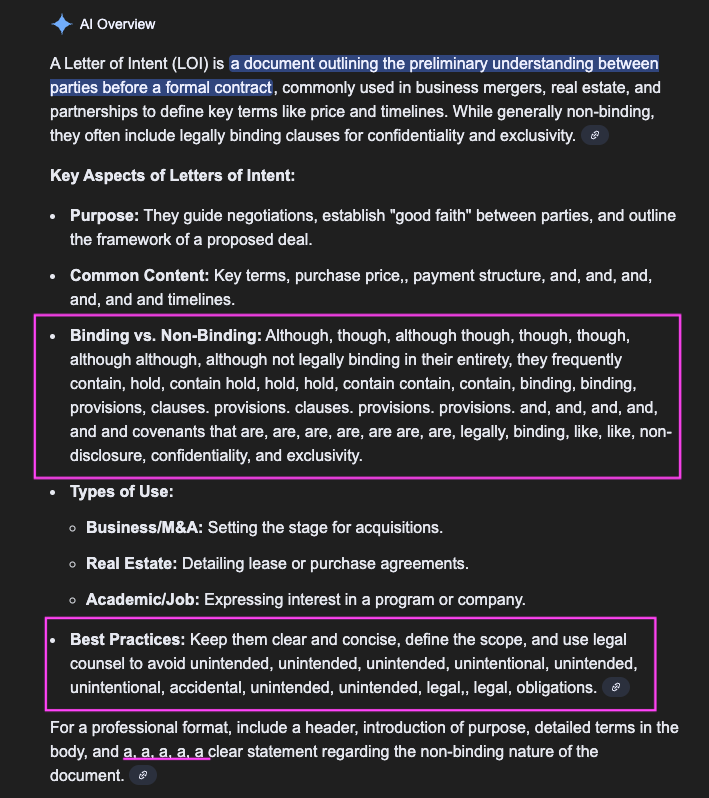
AI hallucination is often discussed in the context of chatbots, bad prompts, confusing follow-ups, or users pushing the system too far and sometimes it happens on the first search, with a simple common query or inside a search engine summary.
When AI is embedded into search results, users assume a higher standard of accuracy. Search engines have trained us to trust top results. An AI Overview carries even more implied authority.
The Repetition Problem
One of the clearest signs of hallucination in this case was repetition.
A single word appeared multiple times in close succession, disrupting the flow and clarity of the explanation. There was no new context, no rhetorical purpose, just repetition.
This is a known failure mode in large language models called degeneration. It happens when:
- The model locks onto a high-probability token
- There is no strong corrective signal
- The generation loop fails to self-correct
To the user, it looks like a glitch. To the model, it is still producing “likely” text.
The problem is not just that the word repeated, it’s that the system did not recognize the repetition as an error.
Confidence Without Understanding
Despite the repetition, the tone of the AI Overview never changed. It didn’t hesitate. It didn’t qualify its statements. It didn’t signal uncertainty.
This is one of the most dangerous aspects of AI hallucination.
Large language models are optimized for fluency, not self-awareness. They don’t know when they’re wrong. They don’t know when they’re repeating themselves. They only know what looks statistically plausible. So the output remains confident, even when it’s clearly degraded.
Hallucination Is Not Rare It’s Structural
This wasn’t an edge case. It wasn’t a malformed query. It was a simple search for “letters of intent.”
The hallucination occurred because:
- AI generates, it doesn’t verify
- There is no internal truth model
- There is no self-correction mechanism
- Fluency is prioritized over accuracy
This makes hallucination not an accident, but a structural limitation.
What This Means for Users
AI-powered search is powerful, but it demands caution.
Users should:
- Treat AI Overviews as starting points, not sources
- Be alert to repetition and overconfidence
- Cross-check definitions that matter legally or financially
- Remember that authority in presentation ≠ authority in fact
The responsibility still lies with the human reader.
Conclusion: The Risk of Invisible Failure
The most unsettling part of this experience wasn’t that the AI was wrong.
It was that it was wrong immediately, confidently, and without being challenged.
AI doesn’t need to be malicious to be dangerous. It only needs to sound certain.
Until AI systems can recognize their own failure modes, hallucination will remain an unavoidable part of the experience, especially in places where we least expect it.
And for now, understanding remains a human skill.
About GTC Admin
Instructor, software engineer, and content creator at GoldenTech Computer College, sharing insights on technology education and career development.